To cast you would not only need to develop the supports but also include grown CAD for shrinkage (the struggle is real), gating, sprues, and feeders in the CAD model to ensure the metal can get to all of the negative spaces when the resin burns out and the metal replaces it:
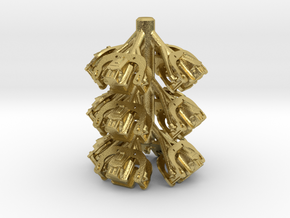
It may be difficult to find a caster willing to cast parts for you, even if you have the printed master, and shipping it? Nope.
If you want to cast yourself, it can be done but you need a crucible/pot to melt the metal, an oven to heat the mold and a way to dip the print into ceramic to coat it or pour a ceramic mold around the print and a way to safely four the metal into the mold. Maybe @robert3985 could correct and expand my thoughts.
Well, since I was developing and casting lost-wax investment cast brass HO scale detail parts for a couple of years about 30 years ago (damn! Has it been that long???) I'll tell ya that to occasionally investment cast parts out of brass is a complicated and precise undertaking and not easily accomplished with "just" this, or "just" that.
When you look at an illustration of investment casting, it looks really simple, and it can be on crude parts, but for small, detailed parts like most of what model railroaders want, it isn't so simple. Casting brass is a bit more difficult than casting gold or silver too since the temperatures are higher and brass will de-alloy if you get it too hot, so you have to have a way to control its melting temperature.
First off, just investing your wax tree, although it sounds simple, is a many-step process with definite steps that cannot be fudged, including how to mix your investment, how long you have to actually invest the tree, which includes how to get the bubbles off of it and make sure that it invades every minute dimple and detail before hardening up. In my process...you needed a rubber canister cap to mount your wax tree into, then a stainless cylinder called a "canister" which fits in a groove near the outside edge of the rubber canister cap after you've built your wax tree. Then, you have to calculate the amount of metal you'll be using, usually by filling up the canister with water and weighing the water, then converting the weight of the water to the weight of the metal you'll need...then adding a bit to compensate for splash. Then, you mix up your investment as per specific instructions, and pour it a certain way into the canister. Then you set it on a special vibrating table to dislodge most of the bubbles hanging on the tree...then transfer the filled canister to a vacuum bell-jar and suck a hard vacuum for a set time....and watch the investment bubble away...then the vibrating table again...then set the filled canister aside.
Then, you fire up the burn-out oven, let it get to a certain temperature, put the filled crucible in it after the investment has set after removing the rubber cap...and you carefully increase the temperature for very specific amounts of time so that the investment doesn't crack and fall apart, that the water in the investment turns to steam instead of just evaporating so that it melts and removes the wax masters and the tree sprues...then in those areas where the wax can't flow out...especially in complex parts like model railroading parts, the remainder of the wax must be totally burned out...vaporized. Your burn-out oven will stink like crazy at this point, so you need a fan hood over it to get the vaporized wax gas out of your work area...then you raise the temp on your burn-out oven so that it's the same as molten brass. Depending on the size of your wax master, this can take a while.
When your burned-out canister has risen to it's required temperature...remember, just because the burn-out oven is at the temp of molten brass...it takes a while for your canister filled with hardened investment to get completely to the right temp through and through...Then you get your metal....I buy my brass in dogfood-sized pellets and put it in a ceramic crucible...add some flux to it...and melt it in a temperature controlled metal-melt furnace. Mine is fueled by natural gas.
You've already wound up your spin-caster in its protective metal-lined housing (mine is about 3' in diameter)...and you open up your burn-out oven, and with a mask on, a protective apron with protective sleeves and gloves...you take your tongs and carefully lift the burned-out canister out of the oven and quickly place it in the spin caster.
Then, you take your molten brass, which is in the ceramic crucible in your metal-melt furnace and place it correctly and quickly in the spin caster so that the nozzle on the crucible is mated to the enlarged opening cast into the investment inside the canister.
Then, you release the spin caster and step back as molten brass always splashes out...and let it spin for a time.
Next, after the spin-caster is done spinning, you let your still-hot canister rest for a bit to ensure the metal inside it is now hard, and you lift it out of the spin caster, and drop it into a large metal bucket of very cold water....and watch the investment crack and explode out of the metal canister.
I let the brass tree sit in the water for a while, then I take it out, blow it off with compressed air, and start removing the big pieces of investment still stuck to it.
After all of the big investment pieces are off...then I put the brass tree into my big ultrasonic cleaner with investment remover, and let it buzz for half an hour or so.
Then, it's nice and bright...all the investment is gone and I start snipping off the parts
Costs are not cheap. I bought my stuff at a large jewelry supply and tool company in Salt Lake City, with a very willing staff and all sorts of casting tools and machinery in a showroom for me to see and get explanations about. I also had to run a gas line to my garage, built a fire-proof space for the ovens and spin-caster, as well as a couple of extra sturdy workbenches and shelves to accommodate my casting equipment and supplies. I would inject and tree up five large canisters of parts in my workshop in my basement, with some canisters holding nearly 1,000 parts if the parts were really small, such as eyebolts or firecracker antennas. I made five vulcanized rubber molds of each part or small kit, so that while I was waiting for the hot wax to harden, I could be injecting additional parts, and removing the cool waxes each time I'd inject another rubber mold, five molds away from removing the waxes. That make sense?? I'd say all the equipment 30 years ago cost me in the neighborhood of three grand. Don't know how much they'd be today...and I didn't get the most expensive versions of everything either.
Anyway, I reserved an entire Saturday each week to do my actual casting, and it took the whole day...like 12 to 15 hours sometimes.
I got to the point of hating it...because it became WORK, so I sold my HO scale masters and molds to some guy in Wyoming, got a divorce and I've never set the whole shebang up again. I do use my wax injector pot and rubber vulcanizer quite often, but I use the local rock shop to do my casting, because it's a lot more pleasant to just deliver the wax masters, and have them do the grunt casting work.
At 25 bucks a canister, it's hardly worth it for me to do it myself unless I was going to start marketing my parts, which I am not planning on doing.
When I get my Photon, one of its main purposes will be to print castable masters for lost-wax casting of small parts that need to be metal, such as switch stands, grade-crossing cross-bucks...things that if they're made of resin or plastic are gonna break very easily and are located close to the tracks where rails must periodically get cleaned. For other details, such as stuff for my U.P. engine modifications, the resin prints will be just fine as-is in most instances unless I want to turn 'em into brass, which I believe will happen rarely.
The guys at the rockshop use a simpler way of casting their small canisters, and the volumes are much less than what I was doing, their canister being about 1/4 the size of mine. For my little parts, their service is perfect and the price is right since I supply the metal and sometimes, the investment.
Hope that maybe give everybody more of an idea what's involved in seriously doing investment casting of small parts.
Cheerio!
Bob Gilmore


