Five years ago today I became a model railroader. January 31st, 2004 I borrowed a friend and his pick up truck to buy lumber at the area Home Depot. Before that I hadn't really thought about trains much since my late childhood 25 years ago. What rekindled my interest after all those years was stumbling onto a Classic Trains magazine at a local book store. For some reason, rather than just flipping through the magazine, I purchased it. The rest, as they say, is history. So, here are some new photos I just took of the layout. The layout
loosely represents the portion of the D&RGW between the east portal of the Moffat Tunnel and Denver, Colorado as seen in October of 1956.
I'll apologize for the photo quality up front. The layout lighting is fine my but lighting for anything other than macro photography is lacking.
The first five photos give you a good overview of the whole layout.

This is the Denver leg of the layout. The area I'm poised to start scenery on now.

The middle mountain section.
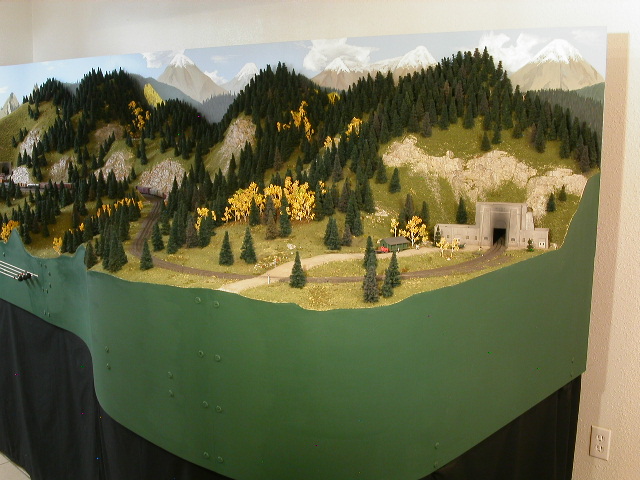
The Moffat Tunnel east portal.

A view looking down the length of the 14' leg towards the 12' long Denver leg.

The 3 track hidden staging yard buried in the mountains.

An F7 led eastbound freight exiting the Moffat Tunnel.

The eastbound freight continuing down grade.

FT led westbound freight waiting in the hole at Crescent Siding for the eastbound freight.

The eastbound freight meeting the westbound freight at Crescent Siding.

The eastbound freight descending past Crescent Siding.

The eastbound F3 led California Zephyr crosses over South Boulder Creek as it passes the tail end of a westbound freight waiting for the Zephyr at Crescent Siding.

The eastbound California Zephyr crossing Coal Creek as it heads over Hwy 72.

The California Zephyr arriving on the outskirts of Denver.

Our Eastbound freight arrives at Denver's Burnham Yard.

A freight working its way through Denver.

Lastly, a shot of the locomotive facilities.
It's been quite an experience. All in all I’d say I’m happy with my efforts, not too shabby for my first layout. There is still plenty to do, structures to build, scenery to add, etc. I’ve learned a lot along the way and have compiled the list below over time on what I’d do better next time around. It’s a self critique and obviously may not apply to others or their efforts. My advice to anyone who is sitting on the sidelines with an urge to get into model railroading is, jump right in. The real fun comes from
doing.
Things I'll do differently on the next layout
1. Make the base layout height chest level, 54 inches (currently 42 inches). This will enhance realism by bringing the layout closer to eye level.
2. Make all the passing sidings exactly the same length. If one is an inch or two shorter than the others, it does matter as far as maximum train length goes.
3. Use real photos to reference while painting the backdrop. This should help achieve more realistic backdrop scenery and clouds.
4. Match the backdrop colors more closely to the scenery colors by purchasing the scenery materials before the backdrop has been started and then match the backdrop paint to the materials.
5. Pay close attention to what the real scenery colors look like for the location and season to be modeled. Purchase accordingly.
6. Have the scenery form blend into the backdrop in a realistic, believable manner, rather then just end at the highest point of the landform into the backdrop. This will make the scenery /backdrop transition more seamless.
7. Use a more realistic base color to paint the scenery. If a bare area shows through, a more realistic base color will look more believable.
8. Be sure to make the terrain features as believable as the situation allows. Try to keep the interaction between mountains, bridges, roads and waterways realistic.
9. When modeling a rocky location use more rock molds. Don’t skimp. The believability and realism will be greatly enhanced by having more rock faces, especially in vertical or near vertical areas.
10. Have less ground foam coverage. Leave more ground surface exposed. This is more realistic in rocky type terrain. Vegetation coverage is not very uniform in the real world.
11. Be careful when using ground foam on extremely steep surfaces. In the real world soil and vegitation rarely collects on these types of areas.
12. Have a larger staging yard. A larger yard equals more trains!
Erik


