I guess I made the same arguments in my two part article series in N-Scale Magazine called "Philosophy of Kitbashing" (Nov/Dec 2007 and Jan/Feb 2008). I have no doubt my modeling drives some people crazy since they don't think like I do. But I have fun, and that's what matters to me.
In part one of the article, I argued for knowing at least the key identifying features (I used diesel locomotives since that's my favorite subject). No matter what, you must at least get these correct. Don't do like Lionel does and make a "GP40" that has a turbo-charged exhaust and has two radiator fans. Sorry, but that's not a GP40. Whatever they key identifying features are, you MUST get those correct so that a casual glance by someone who is fairly knowledgeable about locomotives would say--- Ohhhh. I see you made a xxxxxx. Wow (even if it has compromises).
From there, the effort versus accuracy balance comes into play. I focused not so much on the philosophical beforehand process (the sweet-spot) but the end product of the decision-making process. I came out with three categories of end product.
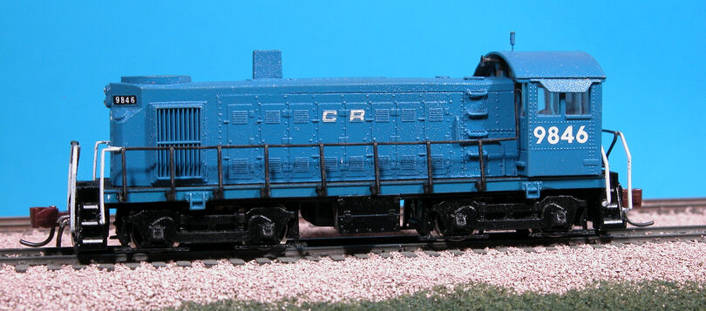
1. When the effort is not worth it, and you make a good bit of compromises, we might call this a Reasonable Facsimile.
I don't know if I like that term. It's not all that catchy. Good approximation is too general, but still fits.
A rivet counter would have a "hissy-fit" (as we say in the deep South, or "go into hysterics"), but from a distance, in spite of the compromises, the overall effect is clear of what this locomotive is supposed to be. And as long as you're happy, that's all that matters (the sweet spot).
Here is one of my locomotives I consider to be in this category.
An Alco T-6. If you get your Pennsy or Conrail book out and look closely, you'll see several differences.
2. Decent Kitbash
This category is still not terribly accurate, but it is closer than the first category. This one is a pretty decent kitbash. The locomotives in this category are good enough that generally only the very knowledgeable rivet-counters would know all the technical flaws.
I confess, a good number of my kitbashes through the years have fallen into this category.
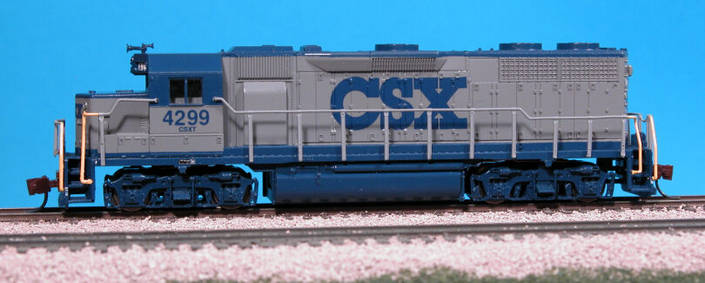
Here's one. A GP39. C&O/Chessie/CSX was the only owner of the GP39 with dynamic brakes, if I remember correctly, so it's not a common loco.
What I did was simply take an Atlas GP38 early version and simply a) cut off the two exhaust stacks and then b) I added a turbocharged exhaust stack from castings I made from a Kato SD40. That's it.
Now, technically, if I remember correctly, the engine compartment should be moved back just a little bit (but not a lot -- it's moved back a whole lot on some of the DASH 2 models). And there might be some other very minor changes.
But notice.....
a. The exhaust stack change was so absolutely easy -- I mean this is soooooo simple.
b. the other changes were so visually minor
c. and so few people would ever know the difference
that the extra effort just wasn't worth it. (and of course, now-a-days.... if it WAS that important to me or you, Mark IV makes a WONDERFUL casting).
So here's my "decent kitbash"- GP39
3. And so the third category would then be a Fairly Accurate Kitbash.
I guess that's where you take a lot more effort to get the model as accurate as possible- not necessarily detailing, but on the kitbashing side.
I haven't done quite as many models here.... although, we have some guys on this board who do great work and produce a lot of models in this category, from what I've seen.
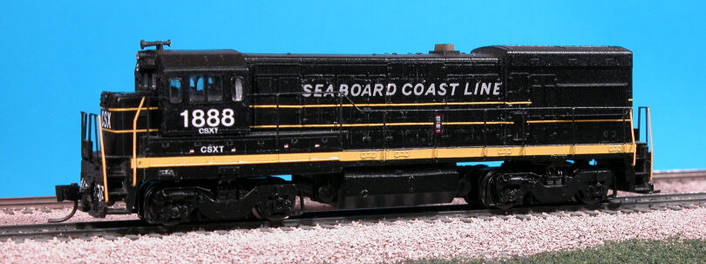
Here are two of my models that I might place in this category.
Seaboard Coast Line U18B (actually this one is not accurate yet because I still need to cut the fuel tank down smaller for this road number- the 18xx series were the lightweight ones. But the rest of mine are still undec right now.)
RF&P GP35 phase 2c

By the way, in part two of the article series, I take a fictitious example of thinking through kitbashing a GP60 phase 1a (I guess that's what some people might call the GP60 demo model). I look at all it would take and then walk through my own personal decision-making processes on the list of 12 specific changes that would have to happen to a Life Like model.
As always, the goal is to have fun.
Ron Bearden


